
MIC Radiologists Involved in Research and Teaching at the U of A
For MIC radiologist Dr. Gavin Low, the instinct to question and to stay at the “forefront of knowledge” has led to a busy research career at the University of Alberta.
The U of A radiology professor says he focuses on clinical research that could lead to better patient outcomes. His goal is “trying to understand the disease process better or finding a technique that maybe improves things for patients,” he says.
He’s one of many MIC radiologists who teach and conduct research at the University of Alberta. And most MIC radiologists are also involved in clinical teaching for U of A radiology residents, helping them with on-the-job training.
An Inquisitive Mind
Much of Dr. Low’s research looks at how effective MRI, CT and ultrasound scans are in evaluating lesions in the abdomen and pelvis, such as liver cancers, and kidney and ovarian masses.
Recently, his research has involved more common conditions, including thyroid nodules and a type of liver disease called hepatic steatosis, or “fatty liver” disease. That work investigates the use of ultrasound and MRI elastography to determine the severity of liver disease.
“This is helpful because a large amount of people around the world have fatty liver disease,” Dr. Low says. While treatment options – including diet and exercise, and even weight-loss surgeries and drugs – can improve the condition, he says it’s important to track the effectiveness of those interventions. “What you need to do is evaluate the liver before and after and see if the steatosis improves,” he says.
Opportunity for Growth
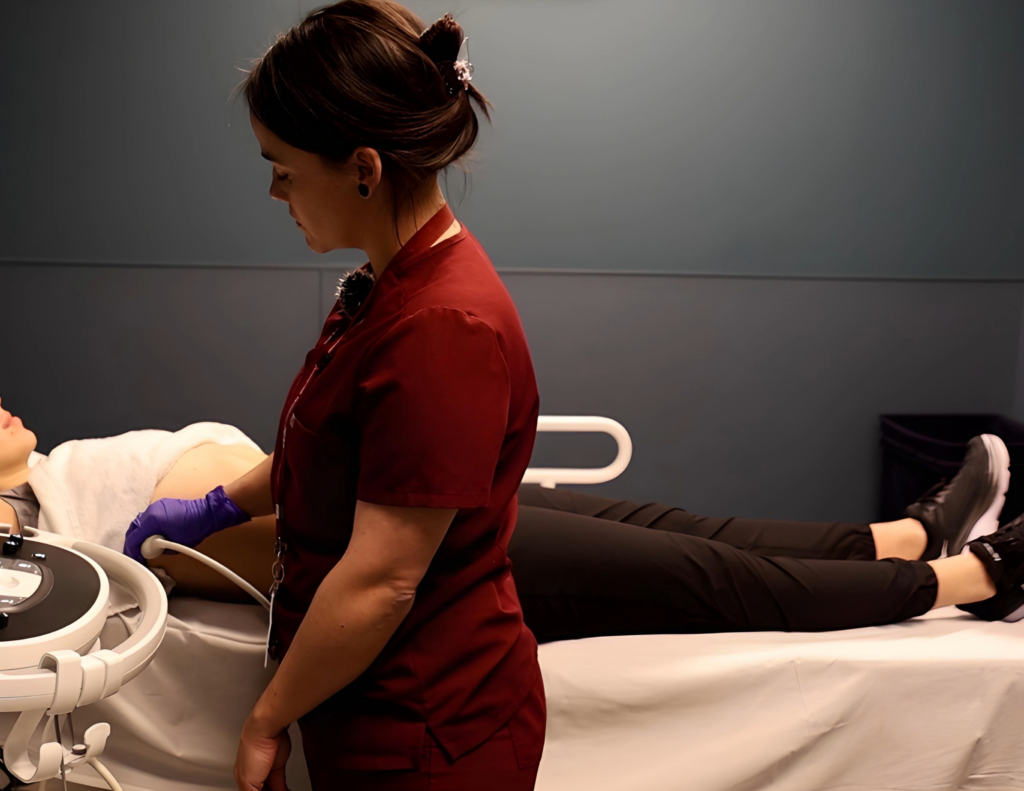
And MIC technologists also have opportunities to contribute to research, says ultrasound technologist Toni Whitaker, who helped with Dr. Low’s elastography research.
For the study, she recruited volunteers, as well as other MIC sonographers to help perform the exams, and then documented the results. Since then, she’s participated in other research, including a project using AI to evaluate pathology.
Her enthusiasm “created a reputation that I was an open door for new, innovative projects,” says Whitaker. She recently won MIC’s Excellence in Innovation Award for her ongoing efforts.
Since graduating from NAIT’s Diagnostic Medical Sonography program in 2017, Whitaker has continued to learn, training in various specialties. Today, as a clinical educator at MIC, she develops continuing education for ultrasound technologists, both new and experienced. “Things are always changing in our field, and that flexibility (to learn) is so important to our role,” Whitaker says.
Mentoring the Next Generation
“They all have a thirst for knowledge.”
At the University of Alberta, Dr. Low also encourages others to push their academic boundaries. As a professor, he teaches mostly radiology residents and fellows, but also medical students and residents from other specialties. “They all have a thirst for knowledge. And I find that infectious,” Dr. Low says.
He’s also director of the fellowship program, which trains radiologists in sub-specialties. Through these fellowships, which are funded primarily by MIC Medical Imaging, they gain expertise in areas such as pediatrics, MSK or neuroradiology, says Dr. Low, who has a fellowship in body imaging from the U of A.
Dr. Low’s dedication to teaching is well recognized. Radiology residents have voted him teacher of the year six times since 2015. “I’ve been very grateful for the mentors that I’ve had,” Dr. Low says, especially those in the United Kingdom, where he did his medical and radiology training. “They’ve passed their knowledge to me, so it’s my responsibility to pass this to the next generation.”